

Taylor Swift prediction markets on Kalshi are Yes/No event contracts tied to outcomes you can verify later, charts, announcements, NFL attendance, and yes, the Travis Kelce rumor cycle. Prices run from 1¢ to 99¢ and the price implies probability. The punchline is right there in the data: one Swift contract shows $575,615 in volume while “Yes” is sitting at 90¢. Tons of attention, a very opinionated crowd, and a rulebook waiting at the end to settle it.
Want the full breakdown of how Kalshi works, fees, and eligibility? You can learn more about Kalshi and the Kalshi Referral Code by checking out our review.
TL;DR
- You trade Yes/No event contracts, not point spreads.
- 1¢ to 99¢ prices imply probability (2¢ reads like roughly 2%).
- Settlement is binary: the winning side is worth $1 per contract, the other side settles to $0.
- Volume is a thermometer for attention and churn, not “truth.”
- Open interest (when shown) is a different thermometer: how many positions are still open.
- Swift contracts can whip around on headlines, but the finish line is always the rulebook.
What Are Taylor Swift Prediction Markets?
These contracts turn “Will Taylor Swift…” questions into something that can actually settle cleanly. Think chart milestones, announcement deadlines, or documented appearances. Not “how many times will she be shown live” on a broadcast, not vibes, not body-language TikToks.
That’s why Taylor Swift works here. Her world produces public signals on a schedule: Billboard updates, official posts, tour news, and regular season logistics when the Kansas City Chiefs are involved. Traders don’t just talk about the story here, they buy and sell contracts tied to what can be proven.
How Kalshi Event Contracts Work
Price, Implied Probability, And Settlement
Every contract has two sides: Yes and No.
- Prices trade from 1¢ to 99¢.
- The price implies probability. If Yes is 82¢, the crowd is pricing roughly an 82% chance of Yes.
- At settlement, the correct side is worth $1 per contract. The other side settles at $0.
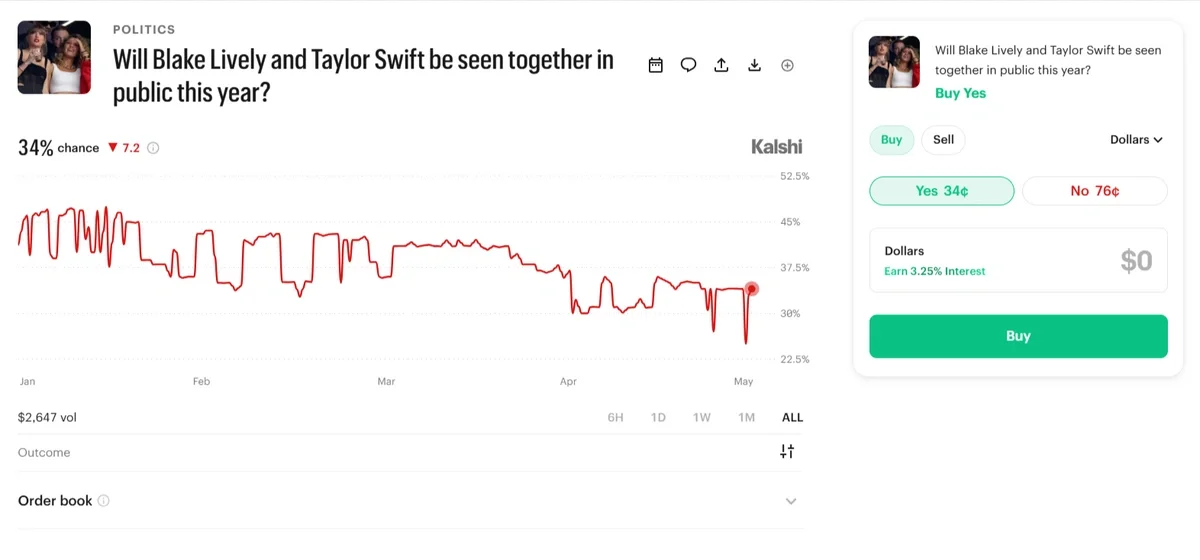
Take the “Will Blake Lively and Taylor Swift be seen together in public this year?” contract shown in below: Yes 34¢ / No 76¢. Mechanically, that’s it. You can open a position by buying one side, and you can close it later by selling, or you can hold through settlement. The contract’s value is always anchored to the same thing: what the rules say counts as proof at the end.
Volume and Open Interest Are Your Market Thermometers
Volume answers "how much activity has flowed through this contract?" while open interest (when shown) answers "how many contracts are still open right now?"
They’re related, but they’re not twins. You can have huge volume because everyone is changing positions in and out, and you can have high open interest because a lot of people are planted and waiting. Neither one guarantees an outcome. They just tell you how crowded and emotional the room is.
Volume ≠ Truth
A Swift contract can be loud without being optimistic. For example, a Top artist on Spotify this Year contract shows $381,395 in volume while “Taylor Swift” is priced at Yes 7¢. That combo doesn’t mean traders secretly think "Yes" is unlikely. It means the contract stayed active. Volume is turnover: traders entering, exiting, and re-pricing the same outcome as new information lands.
In celebrity contracts, the crowd usually piles into the same side, trades around timing, and churns positions on every headline, chart update, or rumor correction. Treat volume like a heat map for attention and liquidity, then go read the rule and calendar. Those decide what has to happen, not the noise.
Read Next: Open Interest vs. Volume at Prediction Markets: A Guide for Traders
Novelty Props vs. Verifiable Settlement
Taylor Swift prop bets are usually where the Super Bowl nonsense lives: how many times will Taylor Swift be shown live, what happens after a Chiefs win, will there be a Travis Kelce kiss, what’s the national anthem angle, and every other Super Bowl prop that has nothing to do with receiving yards, team scores, or defense.
Kalshi contracts are built differently. The contracts are written around outcomes that can be verified later, with sources spelled out in the rules. Still fun, still pop culture, just a lot less “trust me.”
Read Next: Taylor Swift Bridesmaid & Travis Kelce Groomsmen Odds
Latest Taylor Swift Kalshi Markets Odds
This table was last updated on 05//26/26.
|
Market |
Latest Price Shown (Yes) |
Latest Price Shown (No) |
Volume |
|---|---|---|---|
|
Where will Taylor Swift and Travis Kelce’s Wedding occur? (New York) |
76¢ |
25¢ |
$1,278,586 |
|
Who will have a #1 song on Spotify USA in May (Taylor Swift) |
3¢ |
97¢ |
$960,806 |
|
Will Taylor Swift and Travis Kelce be married before Jan 1, 2027? |
91¢ |
10¢ |
$575,772 |
|
Top artist on Spotify this Year (Taylor Swift) |
7¢ |
96¢ |
$381,445 |
|
Reputation (Taylor’s Version) Announcement |
32¢ |
75¢ |
$2,027 |
What These Numbers Suggest About Trader Behavior
Top artist on Spotify this Year: Taylor Swift "Yes" 7¢ With $381,395 Volume
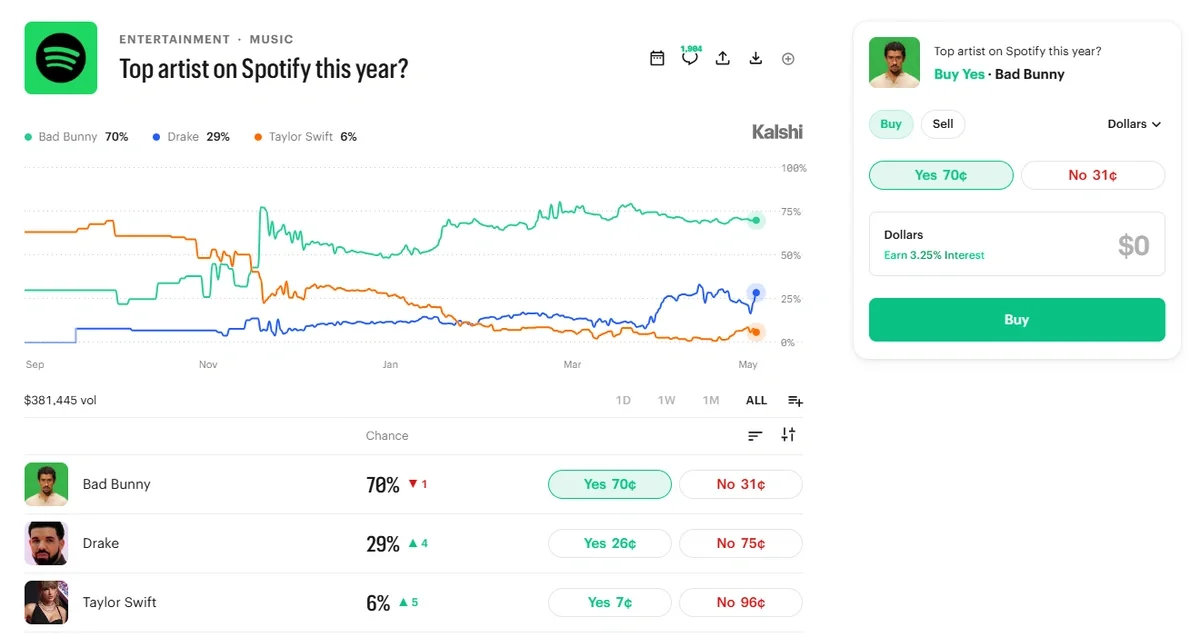
Taylor Swift "Yes" is 7¢ with $381,395 in volume. That’s a classic “high attention, low belief” setup. Traders are clearly involved, but pricing around 7¢ suggests the market still views Swift as a long-shot outcome. Contracts like this often stay active for months as attention remains high while belief in the outcome stays limited.
Rules summary: If Bad Bunny is the most streamed Spotify artist in 2026, then the market resolves to "Yes".
Swift + Kelce Marriage: "Yes" Last Traded 91¢ With $575,615 Volume
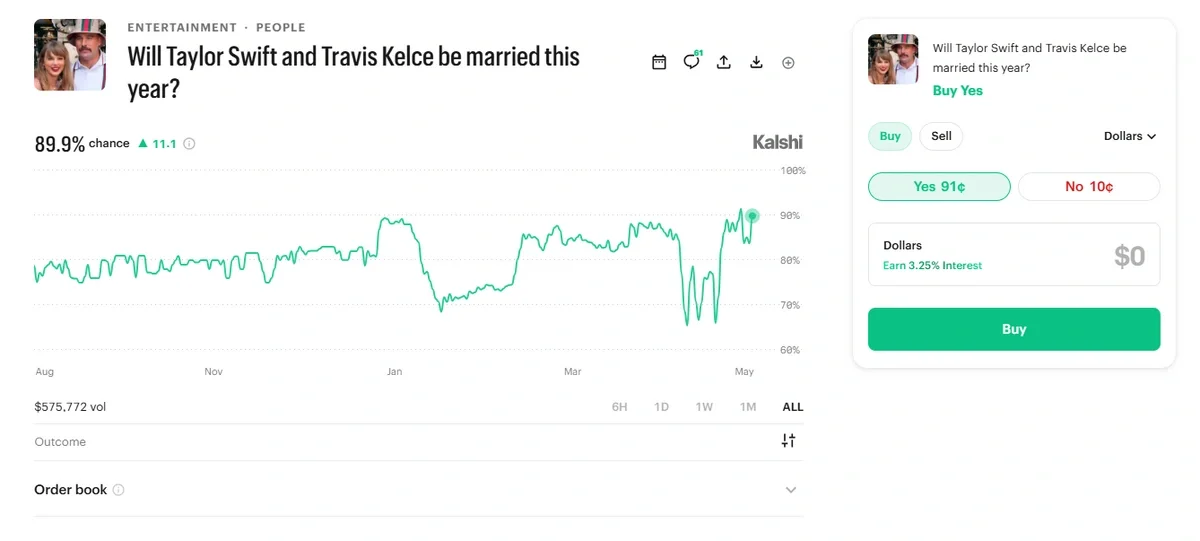
"Yes" last traded at 91¢ with $575,615 in volume. That’s a classic high attention, high belief setup. Traders are clearly engaged with the storyline, and pricing near 91¢ suggests the market leans strongly toward the outcome happening. These contracts can stay active all year as headlines move attention, even while belief in the end result stays relatively steady.
Rules summary: If Taylor Swift and Travis Kelce are married before Jan 1, 2027, then the market resolves to "Yes".
Rumor Vs. Receipt
The Taylor Swift + Travis Kelce marriage contract is a clean example of rumor trading versus receipt-based settlement. It shows $575,615 in volume while Yes last traded at 91¢, which usually means traders are reacting to headlines while the overall belief in the outcome stays high. A photo sparks buys, a debunk sparks sells, and the volume prints either way.
This contract resolves "Yes" only if Swift and Kelce are legally married before Jan. 1, 2027, with verification based on official records and a strict source hierarchy. When the proof bar is that high, rumor-driven price swings can fade quickly, especially once the same story starts cycling again.
Reputation (Taylor’s Version) Announcement: "Yes" Last Traded 32¢ With $2,027 Volume
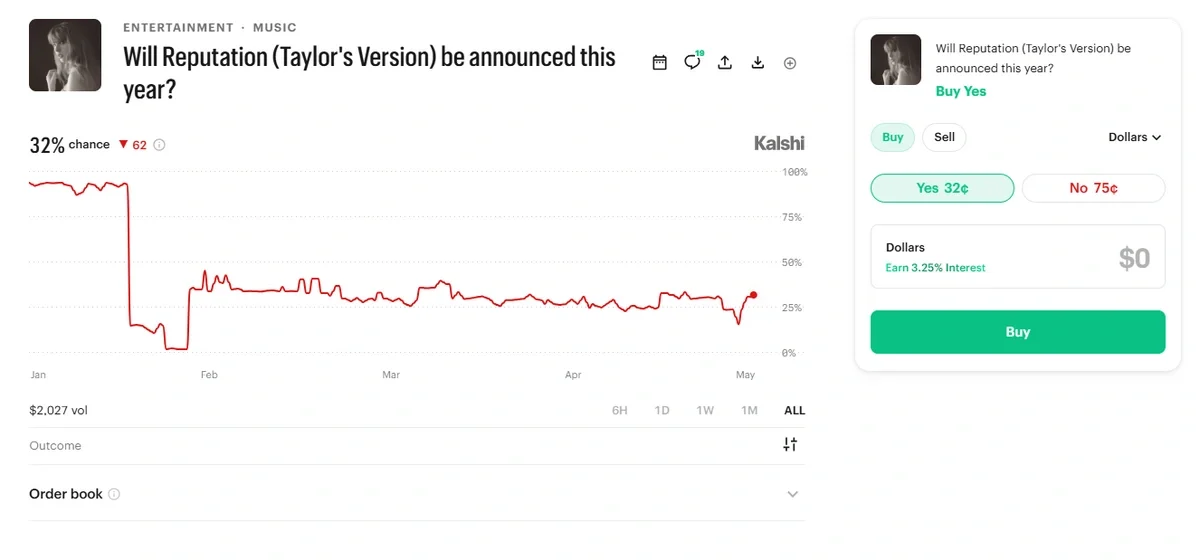
"Yes" last traded at 32¢ with $2,027 in volume. That’s a low attention, split belief setup. Traders are clearly watching the possibility of Reputation (Taylor's Version), but pricing around 32¢ suggests the market still treats an announcement as uncertain. Announcement contracts like this often drift for long stretches, then jump when traders decide a hint from Taylor Swift is real — or when the calendar starts to matter more than speculation.
Rules summary: If Reputation (Taylor's Version) has been announced before Jan 1, 2027, then the market resolves to "Yes".
Who will have a #1 song on Spotify USA in May: Taylor Swift "Yes" 4¢ With $965,039 Volume
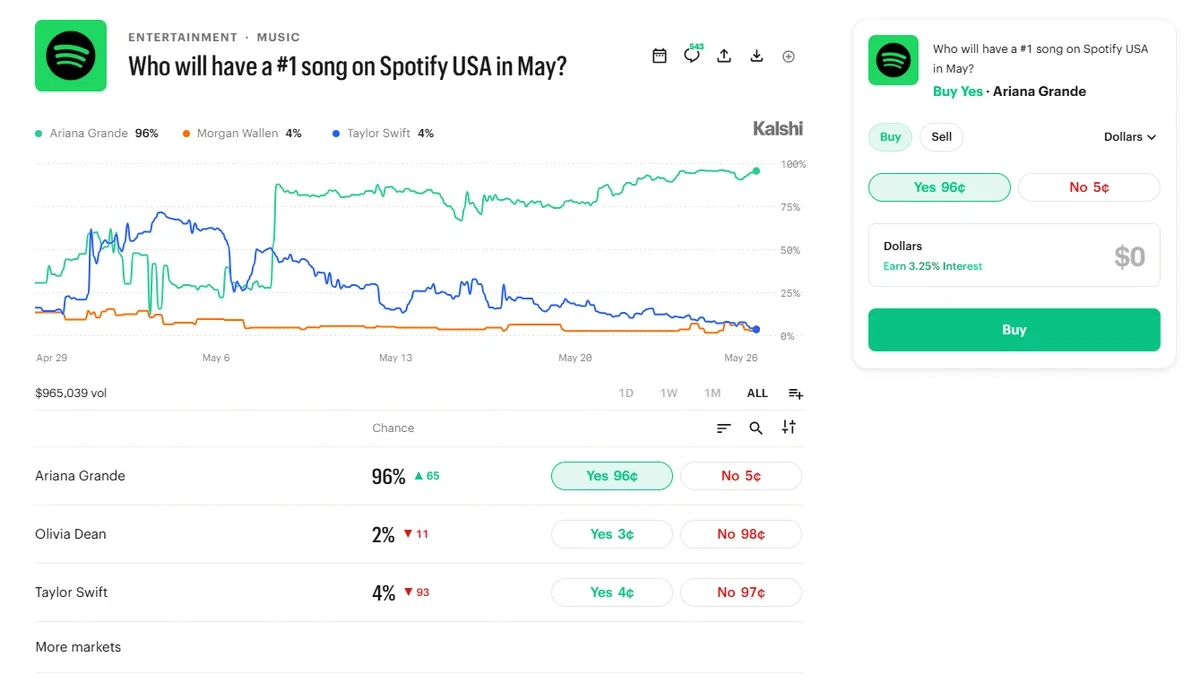
Taylor Swift "Yes" is 4¢ with $965,039 in volume. That creates an interesting setup: high market activity, but very little confidence that she will actually claim the No. 1 spot. Music markets often see heavy trading around releases, social buzz, and chart momentum, even when traders view an outcome as unlikely.
Rules summary: If Ariana Grande is #1 on Any Spotify Daily Top Songs USA chart in May 2026, then the market resolves to "Yes".
Other reads - Reality TV Prediction Markets & Who Will Win The Bachelorette? Live Odds
Taylor Swift + Travis Kelce: The NFL’s Most-Watched Romance
When Taylor Swift started showing up around Kansas City Chiefs game days, the NFL got a weekly plotline with built-in distribution. Travis Kelce wasn’t just running routes, he was part of the crossover episode, and football fans treated every clip like it had to mean something.
That’s also why the conversation slides into Taylor Swift prop bets and Super Bowl prop chaos so easily. You’ve seen it: how many times will Taylor be shown live, who’s in Eagles gear or Chiefs gear, etc. Throw in Super Bowl LVII flashbacks, Jalen Hurts discourse, Patrick Mahomes highlights, and random “what if it’s like the Los Angeles Rams game” spirals, and you get nonstop attention.
The difference here is that Kalshi forces that attention into something stricter: contracts tied to outcomes with receipts. Same buzz, cleaner settlement.
Other reads - Rotten Tomatoes Kalshi Prediction Markets
How Do Betting Markets Frame Swift? The Taylor Swift Effect on Sports & Markets
The “Swift Effect” is basically what happens when pop culture attention starts moving prices like it’s part of the broadcast. One Sunday it’s a normal game, the next it’s a full internet case file, and the conversation has nothing to do with team scores and everything to do with Bad Blood or Wildest Dreams playing in the background.
That doesn’t mean every contract becomes “true.” It means traders show up, volume climbs, quotes move, and people get involved. Sometimes it’s because of an announcement, sometimes it’s because the internet decided a screenshot was evidence. If you’ve watched the same thing happen with a Kendrick Lamar rumor or a Saquon Barkley headline, you already understand the pattern.
The way to stay sane is boring on purpose: treat each contract like its own rulebook. What has to happen, by when, and what counts as proof.
Other reads - GTA 6 Kalshi Prediction Markets
Novelty Prop Betting & Why Taylor Swift Is Different
Every Super Bowl comes with the same set of novelty bets: coin toss, Gatorade color, how long the national anthem will run. They’re fun, they keep casual fans entertained, and they give sportsbooks a little extra action outside of scores and receiving yards. But those props live in the shallow end of the pool. Nobody’s future hinges on whether the Gatorade is blue or orange.
Bring Taylor Swift into the mix, and the water gets a lot deeper. Her name isn’t just another novelty line item, she’s not a side bet, she's the end game. It moves prediction markets with serious money behind them. Hundreds of thousands of dollars have traded on whether she’ll headline a future Super Bowl halftime show (Kalshi saw more than $272,000 on the question of whether she would be the performer for Super Bowl LX or not). That’s not filler action, that’s real capital following the gravitational pull of a pop star.
And that’s what sets Taylor Swift prop bets apart. They don’t sit neatly beside coin tosses or anthem lengths. They sit at the crossroads of pop culture, sports, and finance, where her influence gets measured not just in chart positions or Philadelphia Eagles win totals, but in tradable contracts.
Whether you’re a Swiftie or just a bettor looking for the edge, you can feel that shift. This is proof of how celebrity, sports, and trading have fully collided.
If you know fellow Swifties who want to trade on Taylor Swift and other markets, learn how to refer friends to Kalshi and earn rewards!
Not really. Legal sportsbooks rarely post Taylor Swift prop bets like “how many times is she shown live” during the Super Bowl, or other novelty angles tied to the national anthem. When that stuff exists, it’s usually treated like entertainment (think Travis Kelce propose rumors or “Eagles gear” type chaos that sounds like it was written by an Eagles fan). Kalshi is different: you’re trading event contracts that settle on defined rules.
Each contract is a Yes/No question. Prices trade from 1¢ to 99¢, the price implies probability, and settlement is binary: the winning side is worth $1 per contract and the other side settles to $0. You can hold a position to settlement or close it by selling.
Because the inputs are human and the timeline is noisy. The internet trades screenshots like they’re evidence (sometimes they are, sometimes they’re not). The problem is the contract still settles on receipts, and that’s the part people forget when the story gets loud.
Trades. Prices move when people buy and sell. The biggest catalysts are official announcements, credible reporting, verifiable appearances, and milestone tracking. Rumors and debunks matter too, especially in the Travis Kelce-related contracts, because they create churn even when the underlying outcome stays unlikely.
Think of them as thermometers. Volume measures how much activity has traded over time, while open interest (when shown) measures how many positions are still open. High volume can mean a frenzy, high open interest can mean a crowded view. Neither one guarantees what will happen.